

In the high-stakes world of modern entrepreneurship, there is an almost obsessive focus on raising venture capital (VC). We read headlines every single day about pre-revenue companies securing massive multi-million dollar seed rounds, accelerating toward unicorn status overnight. But what these flashy tech narratives don't tell you is the stark reality of the startup ecosystem.
For the vast majority of founders, the path to building a sustainable business looks very different. It requires grit, relentless customer focus, and a deliberate, methodical approach. This is where a startup booted fundraising strategy comes into play.
Wait, isn't a "startup booted fundraising strategy" an oxymoron? Not quite. A true startup booted fundraising strategy means using your own customer revenue, extreme capital efficiency, and strategic timing to fund your growth, maintaining absolute control until you decide (if ever) that external capital is necessary.
At Sovereix, we believe in empowering founders to build sustainable, financially resilient businesses. In this comprehensive guide, we will break down the exact strategies, real-world data, and tactical frameworks you need to successfully bootstrap your startup and leverage it into a powerhouse.
What Does It Really Mean to Bootstrap Your Startup?
Bootstrapping means starting and growing a company using your own personal finances and the operating revenues of the new company. You are literally pulling yourself up by your own bootstraps.
Instead of spending months pitching angel investors and venture capitalists, bootstrapped founders spend their time pitching actual customers. They prioritize product-market fit, sustainable unit economics, and immediate cash flow over vanity metrics.
The Reality of VC Funding (Data & Facts)
Before we dive into the strategy, let's look at the hard data. The media heavily skews our perception of how companies are built.
- The Rarity of VC Capital: According to extensive industry data, fewer than 0.05% of startups actually receive institutional venture capital funding in any given year. The overwhelming majority of successful businesses are self-funded or rely on traditional small business loans.
- The Path to Profitability: Bootstrapped startups exhibit significantly higher capital efficiency. Estimates show that 56% to 60% of bootstrapped startups reach profitability within their first three years. In contrast, only 18% to 35% of VC-backed companies achieve this, as they are often pushed into "burn-to-scale" models that prioritize rapid market capture over sustainable margins.
- Equity Retention at Exit: This is the most crucial metric for founders. Bootstrapped founders typically retain up to 100% equity at launch and maintain an average of roughly 73% ownership at the time of exit. A typical VC-backed founder, after suffering dilution across multiple funding rounds, might only own a median of 13% to 18% of their company when it goes public or is acquired.
Visualizing the Trade-Offs: Bootstrapped vs. VC-Backed
To help you make an informed decision, here is a breakdown of the core differences between bootstrapping and traditional venture capital funding.
| Metric / Focus | Bootstrapped Startup | VC-Backed Startup |
|---|---|---|
| Primary Funding Source | Personal savings & Customer revenue | Institutional investors & Angels |
| Speed of Growth | Organic, steady, limited by cash flow | Hyper-growth, "blitzscaling" |
| Founder Control | 100% Autonomy | Board oversight, investor mandates |
| Time to Profitability | Fast (often required for survival) | Slow (prioritizes market share over profit) |
| Risk Profile | Personal financial risk, lower failure rate | OPM (Other People's Money), high failure rate |
The "Bootstrap First, Raise Later" Strategy
If your ultimate goal is to build a massive global enterprise, you might eventually need venture capital. However, the most effective fundraising strategy in today's market is the "Bootstrap First, Raise Later" model.
Why You Should Delay External Funding
When you raise money on day one with nothing but a pitch deck and a dream, your valuation is heavily discounted. Investors are taking on maximum risk, and as a result, they demand maximum equity.
By employing a bootstrapped strategy in the early stages, you force your team to prove the concept. You have to build a minimum viable product (MVP), acquire real customers, and demonstrate a working business model.
When you approach investors after achieving these milestones, the dynamic shifts entirely. You are no longer begging for capital to survive; you are offering them an opportunity to pour gasoline on a fire that is already burning. This leverage translates to:
- Significantly higher company valuations.
- Far less founder dilution.
- Better terms and board control.
- The ability to walk away if the deal isn't right.
Actionable Bootstrapping Tactics for Early-Stage Founders
How do you actually survive and thrive without millions of dollars in the bank? It requires a strict adherence to operational efficiency and marketing ingenuity. Here are the core pillars of a successful startup booted fundraising strategy.
1. Focus on Revenue from Day One
In a VC-backed startup, the goal is often user acquisition at any cost. In a bootstrapped startup, the goal is revenue. You do not have the luxury of offering a free product for three years while you figure out monetization.
Build something that solves an immediate, painful problem for a specific niche, and charge for it immediately. Even if your product is imperfect, early adopters will pay if the core solution is valuable. This early revenue becomes your literal lifeblood and your primary source of working capital.
2. Optimize Cash Flow and Keep Burn Rates Near Zero
Bootstrapped founders must be obsessive about their finances. You cannot afford lavish office spaces, massive marketing budgets, or unnecessary software subscriptions.
- Remote First: Build a remote, distributed team to cut down on physical overhead.
- Contractors vs. Employees: Utilize freelancers and specialized contractors before committing to full-time payrolls.
- Pre-sales: Sell your product before you build it. Launching a pre-order campaign or offering lifetime deals can generate the upfront cash required to fund initial development.
3. Leverage Free and Open-Source Tools
You don't need a $10,000 enterprise software stack to run a startup. Utilize robust, low-cost or open-source tools for your infrastructure. From website development (like leveraging Next.js for high performance) to CRM management, the barrier to entry has never been lower.
For your marketing, rely heavily on organic channels. Mastering Comprehensive SEO Audits and content marketing is the ultimate bootstrapped growth hack. If you can acquire customers organically through search engines, your Customer Acquisition Cost (CAC) plummets, increasing your margins drastically.
Furthermore, integrating Automated Email Marketing Sequences (using platforms like Kit) allows you to nurture leads and drive sales while you sleep, effectively giving you a 24/7 sales team for a fraction of the cost.
4. Sweat Equity Over Cash
When cash is scarce, you have to trade equity or time. "Sweat equity" means you and your co-founders are doing the heavy lifting—coding the app, writing the marketing copy, and doing the customer support.
When you do need to bring in early talent, consider offering small equity stakes or profit-sharing agreements in lieu of high salaries. Ensure these agreements are tied to strict vesting schedules to protect the company.
When is the Right Time to Actually Fundraise?
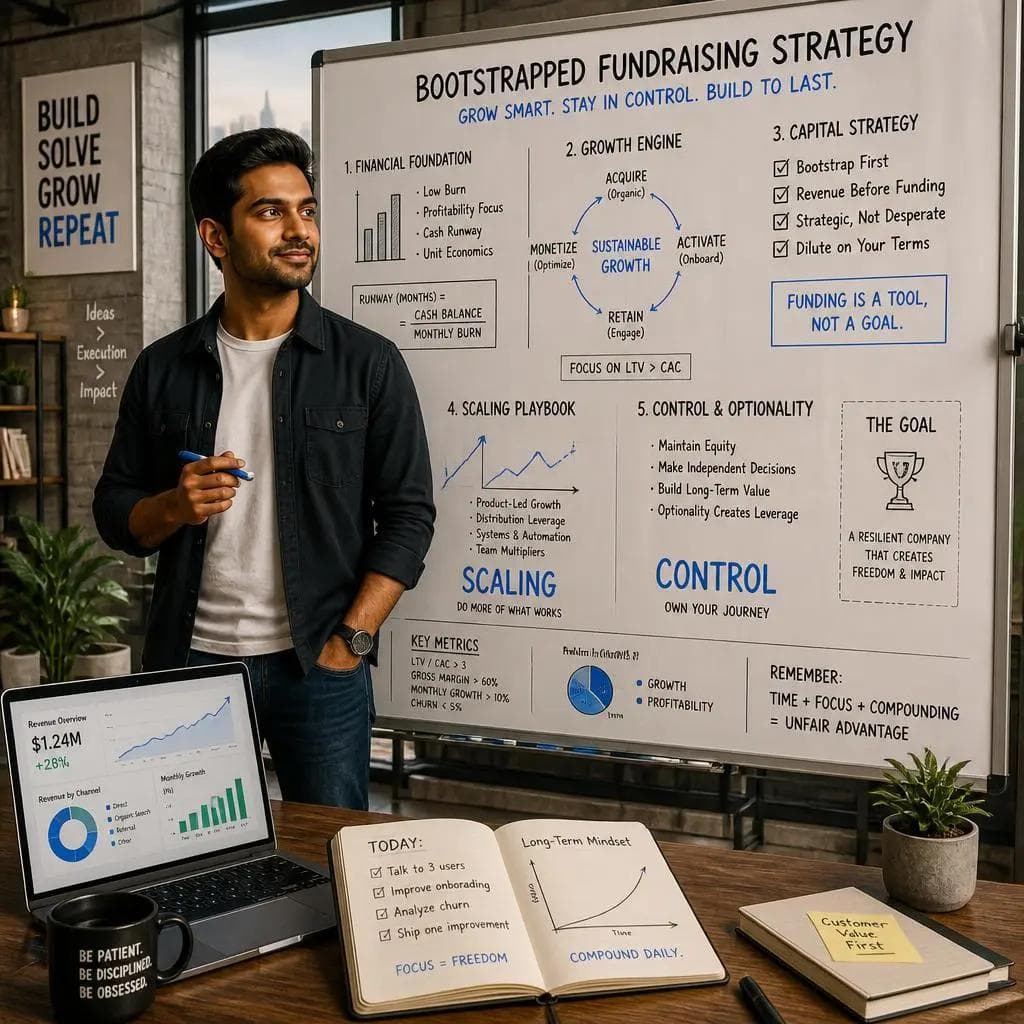
Bootstrapping is a fantastic way to build a foundation, but there are scenarios where bringing in external capital is the mathematically correct decision. The "Bootstrap First, Raise Later" strategy culminates when you hit specific inflection points.
Signs You Are Ready for VC Capital:
- You Have Clear Product-Market Fit: Your customers love your product, churn is low, and organic growth is steady.
- Predictable Customer Acquisition Cost (CAC): You know exactly how much it costs to acquire a customer, and the Lifetime Value (LTV) of that customer is at least 3x to 5x higher than the CAC.
- The "Winner-Take-All" Market Constraint: If you are in a highly competitive market where speed of execution is the only differentiator, bootstrapping might cause you to lose market share to heavily funded competitors.
- Capital-Intensive Scaling: Your model requires massive infrastructure, inventory, or physical expansion that cannot be sustained purely by rolling over monthly revenue.
When you hit these milestones, venture capital transforms from a risky lifeline into a calculated growth mechanism. You can approach top-tier firms like Sequoia or Andreessen Horowitz with a proven machine, asking for the capital simply to turn the crank faster.
Conclusion
The narrative that you must raise millions of dollars to build a successful startup is a myth propagated by the small fraction of companies that actually do it. For the 99% of entrepreneurs out there, a startup booted fundraising strategy is not just a viable alternative; it is often the superior path.
By choosing to bootstrap, you are prioritizing profitability, customer satisfaction, and total founder autonomy. You retain the equity you deserve and build a resilient company capable of weathering economic downturns.
Whether you decide to bootstrap to a lucrative exit, run it as a highly profitable lifestyle business for decades, or use your bootstrapped traction to raise capital on highly favorable terms, the choice remains exactly where it should be: in your hands.
Building a startup is a marathon. Bootstrap the first half, and you'll dictate the pace for the rest of the race.
For more in-depth analyses on startup finance, growth strategies, and maintaining financial sovereignty, continue exploring the resources available at Sovereix.