
For nearly a decade, the global technology sector was defined by a ruthless, capital-intensive conflict. The "Bloodiest Cloud War" wasn't fought on traditional battlefields; it was a relentless war of attrition over data centers, compute power, and hyper-scale dominance. The main combatants—Amazon Web Services (AWS), Microsoft Azure, and Google Cloud—spent hundreds of billions of dollars trying to lock enterprises into their walled gardens.
However, as the Artificial Intelligence (AI) boom accelerated, the old rules of engagement broke down. In early 2026, a paradigm shift occurred that completely altered the trajectory of global computing.
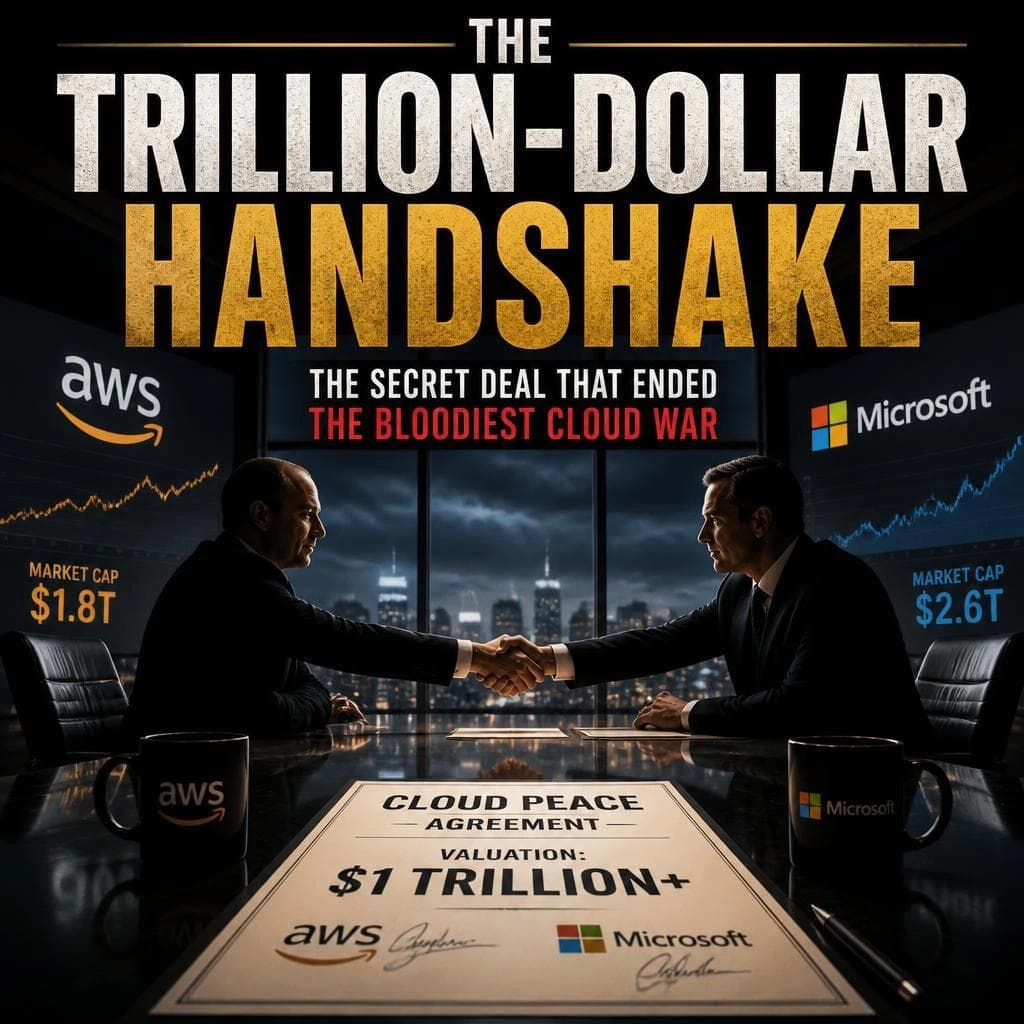
Industry insiders now refer to it as "The Trillion-Dollar Handshake."
This phrase, which gained prominence during high-profile technology summits featuring titans like NVIDIA's Jensen Huang and networking giant Cisco, signaled a foundational pivot toward interoperability. It marked the end of the zero-sum cloud infrastructure wars and ushered in a new era of standardized AI infrastructure. Here at Sovereix, where we focus on helping enterprises navigate digital transformation. We believe understanding this hidden deal is crucial for any forward-thinking business.
If you are curious about our mission or our background in tech analysis, feel free to learn more on our About Page.
The Era of the Bloodiest Cloud War
To appreciate the magnitude of the Trillion-Dollar Handshake, we must look at the battlefield that preceded it. Between 2015 and 2024, the cloud computing market was fiercely territorial.
The major providers aggressively slashed prices on basic storage and compute instances to drive adoption. But this "race to the bottom" had a catch: once a business migrated its data to a specific cloud, moving it anywhere else incurred massive data egress fees. The strategy was clear: capture the customer early, lock them in, and extract value over decades.
Why the Old Model Was Unsustainable
By the time generative AI became the driving force of the global economy, this fragmented model began to crack. AI models require unprecedented amounts of processing power—specifically, Graphics Processing Units (GPUs) and high-speed networking.
- Supply Chain Bottlenecks: No single cloud provider could secure enough silicon chips to monopolize the AI market.
- Customer Frustration: Enterprises were tired of vendor lock-in. A company in Austin, Texas, trying to build an AI application might want AWS's infrastructure but Google's machine learning tools.
- The AI Infrastructure Cost: Building "AI Factories" required investments reaching into the hundreds of billions, pushing even the tech giants to the limits of their capital expenditure budgets.
As detailed in our recent deep dive on AI Governance, the lack of standardized infrastructure was not just an economic issue; it was a severe regulatory and compliance roadblock.
Enter the Trillion-Dollar Handshake: Cisco, NVIDIA, and the New Alliance
The breaking point led to a series of strategic realignments in early 2026. The "Trillion-Dollar Handshake" wasn't a single contract signed in a smoke-filled room. Rather, it was a symbolic convergence of hardware, networking, and cloud software leaders deciding that the pie was big enough for everyone—if they agreed to standardize the oven.
The most visible manifestation of this was the unprecedented collaboration between legacy networking giants like Cisco and AI compute titans like NVIDIA. Instead of cloud providers building proprietary, incompatible data centers, these underlying hardware companies established a unified architecture.
Key Components of the Breakthrough
- Hardware Standardization: The agreement to use common networking protocols (like advanced Ethernet optimizations for AI) meant that compute clusters could communicate seamlessly, regardless of which cloud provider hosted them.
- The Apple-Google Precedent: Around the same time, the "Apple-Google Cloud Alliance" showed that even bitter rivals could collaborate on backend cloud infrastructure to power AI-driven consumer software (such as the integration of advanced Large Language Models (LLMs) into mobile operating systems).
- Cross-Cloud Interoperability: Recognizing that the real money was in AI services rather than basic hosting, the major cloud platforms quietly agreed to lower egress fees and support multi-cloud architectures.
Visualizing the Alliance
To better understand how this deal structured the new digital economy, consider the following breakdown of the "Trillion-Dollar Handshake" ecosystem:
5 Ways the Trillion-Dollar Handshake is Reshaping Tech
The cessation of hostilities in the cloud infrastructure space has unlocked massive value. Here are the top five ways the Trillion-Dollar Handshake has transformed the industry:
1. The Death of Vendor Lock-In
For years, Chief Information Officers (CIOs) lived in fear of committing to the wrong cloud provider. Today, thanks to standardized AI networking, deploying a multi-cloud strategy is no longer a luxury reserved for Fortune 500 companies—it is the baseline standard.
2. The Rise of the "AI Factory"
Data centers are no longer just storage facilities; they are manufacturing plants for intelligence. By agreeing on hardware standards, tech giants are collaboratively building sovereign AI factories capable of processing data at unimaginable speeds. Discover more on how this impacts workforces in our AI and the Future of Work Article.
3. Accelerated AI Innovation
With infrastructure wars out of the way, capital is being reallocated to software innovation. Developers no longer have to build different versions of their AI models for different cloud environments. According to Gartner's recent tech projections, this interoperability is expected to shave years off the development of Artificial General Intelligence (AGI).
4. Geopolitical Stability in Tech
The handshake extends beyond corporate boardrooms. It touches on global supply chains, ensuring that raw materials, semiconductors (particularly high-bandwidth memory from South Korea), and networking equipment flow more efficiently, bypassing some of the friction points of previous US-China trade tensions.
5. Cheaper Enterprise AI Solutions
When infrastructure providers compete on service quality rather than holding data hostage, prices drop. We are already seeing the cost of fine-tuning large language models plummet, democratizing AI for mid-sized businesses. If you're looking to optimize your business's IT overhead, explore the Sovereix.
How Regional Tech Hubs Are Adapting
This global shift isn't just a story for Silicon Valley billionaires. The ripple effects of the Trillion-Dollar Handshake are fundamentally altering local SEO and business landscapes in regional tech hubs.
The Austin and London Connection
Take, for example, the booming tech corridors in Austin, Texas, and London’s Tech City. Historically, local managed service providers (MSPs) in these areas had to aggressively pick sides—branding themselves as "AWS exclusive" or "Azure experts."
Today, local IT consultancies are rebranding as Multi-Cloud AI Integrators. A manufacturing firm in Austin can now seamlessly route its supply chain data through Microsoft Azure's secure enclave, while utilizing Google Cloud's AI algorithms for predictive maintenance. This localized, flexible approach is exactly what modern businesses demand, and it is entirely powered by the infrastructure détente.
By making the cloud agnostic, the Trillion-Dollar Handshake has empowered local businesses to utilize top-tier, enterprise-grade AI without needing an army of proprietary cloud architects. Learn more about navigating localized compliance by visiting our AI Governance Hub.
What This Means for Your Business
If you are a business owner or a decision-maker, the end of the Bloodiest Cloud War is excellent news. It means you have unprecedented leverage.
You no longer have to choose a technology partner based on who holds your data hostage. Instead, you can build a bespoke tech stack tailored perfectly to your operational needs. The focus has shifted from "where is my data stored?" to "what can my data do?"
However, this new found freedom comes with complexity. Managing a multi-cloud, AI-driven infrastructure requires strategic oversight, rigorous security protocols, and a deep understanding of data governance. If your organization is struggling to adapt to these new rules of engagement, we are here to help. Reach out to our experts via our Sovereix Contact Page to schedule a strategic consultation.
Conclusion: A New Era of Collaboration
The "Trillion-Dollar Handshake" will go down in tech history as the moment the industry collectively matured. By realizing that the potential of Artificial Intelligence was too vast to be constrained by proprietary walled gardens, tech titans laid down their arms.
The Bloodiest Cloud War didn't end with a single victor; it ended with a truce that benefited the entire global economy. As we move further into this era of AI factories and seamless digital infrastructure, the companies that thrive will be those that embrace collaboration, prioritize agility, and leverage the multi-cloud ecosystem to its fullest potential.
The infrastructure has been built, the handshake has been made, and the war is over. Now, the real work of building the future begins.
Want to stay updated on the latest shifts in digital infrastructure and AI strategy? Explore more insights on our Sovereix Blog or dive into our comprehensive guide on AI and the Future of Work.